
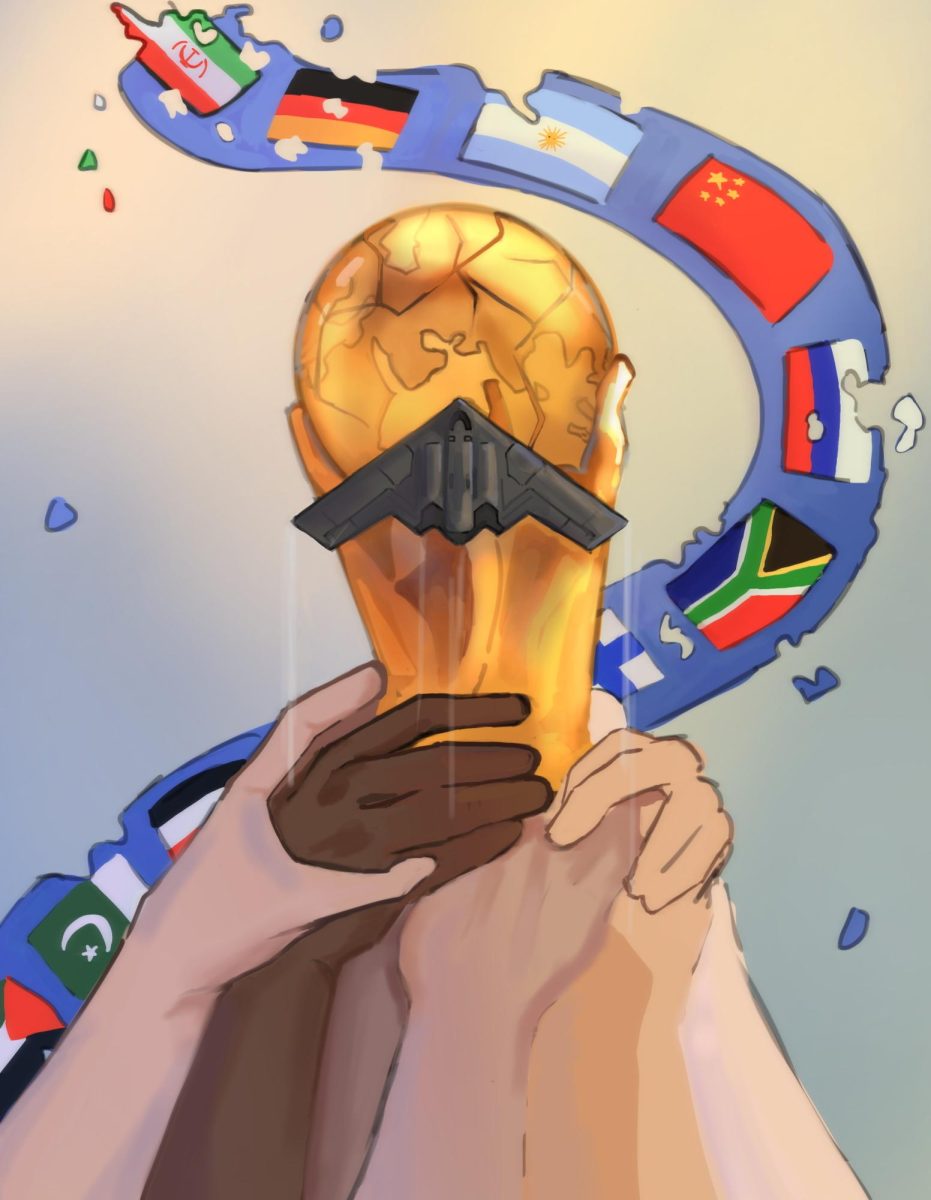















As the countdown to the 2026 FIFA World Cup continues, excitement is building among fans as national teams prepare for the world’s largest sporting event. For the first time in history, the tournament will be hosted across three nations: the United States, Canada, and Mexico.
But behind the preparations and anticipation lies a more complex backdrop. Escalating tensions between the U.S. and Iran, tightened visa restrictions, and ongoing safety concerns within Mexico are raising questions about participation, travel, and security in what is meant to be a global celebration of sport and culture.
U.S. and Iran Conflict
The United States is set to host 78 of the 104 matches in the World Cup. However, conflicts between the United States and Iran have become a significant concern ahead of the tournament. The United States and Israel carried out several airstrikes against Iran, resulting in the death of Iran’s Supreme Leader Ali Khamenei on February 28, 2026. Iran followed with immediate retaliation by targeting US military bases in Israel and other countries in the Middle East. As tensions rose in the following months, Iran’s national team’s participation in the World Cup became increasingly uncertain.
On March 11, Iran’s Sports Minister Ahmad Donyamali stated that “considering that [the U.S.’s] corrupt regime has assassinated our leader, under no circumstances can we participate in the World Cup.”
This doubt grew even stronger on March 12, when U.S. President Donald Trump posted a statement on Truth Social saying he did not believe Iran’s participation was appropriate for the team’s “own life and safety.”
Despite this, on March 31 at the 76th FIFA congress, FIFA president Gianni Infantino confirmed that Iran “will be at the World Cup,” with their opening match against New Zealand still scheduled to be held in Los Angeles on June 15.
While participation has been confirmed, the underlying political backdrop could seep into the matches. Any games involving Iran—particularly those set in the United States—are likely to be surrounded by heightened tension and increased security.
U.S. Visa Restrictions
Alongside geopolitical pressures, the tightening of the United States’ visa restrictions may also threaten the success of the upcoming World Cup.
On January 1, 2026, the United States imposed sweeping visa restrictions on nationals from 39 countries. Of those countries, four qualified for the World Cup. The ban operates on two tiers: 19 countries face a full suspension, with nearly all visas blocked, while the other 20 face a partial suspension.
Haiti and Iran, both World Cup qualifiers, face the full ban, making it nearly impossible for most of their fans to enter the United States. Ivory Coast and Senegal, also qualifiers of the tournament, fall under the partial ban, which blocks tourist and visitor visas–the exact categories of visa a fan would need to attend a match.
Of the 39 countries, 26 are from Africa—making up two-thirds of the entire ban list. The tournament risks fewer diverse groups being represented in the crowds, and thousands of people missing the rare opportunity to experience the tournament’s electric atmosphere in person.
These restrictions risk undermining the World Cup’s image as a tournament built on global unity and inclusivity, and could limit the competition’s ability to serve truly as a global event.
Conflicts in Mexico
Mexico is set to co-host the World Cup in three cities, including Guadalajara, which is set to host four games. However, within the city of Guadalajara, recent events have raised concerns about the safety of the World Cup games in Mexico.
On February 22, 2026, the Mexican military assassinated Nemesio Oseguera Cervantes, also known as “El Mencho”. El Mencho was the leader of the Jalisco New Generation Cartel (CJNG), known as one of the most aggressive and rapidly expanding cartels in Mexico. The CJNG has an estimated worth of 13 billion U.S. dollars and has tens of thousands of members. They are said to be responsible for numerous massacres, kidnappings, and killings of politicians.
In response to El Mencho’s assassination, followers and members of the cartel immediately hit the Mexican streets—blocking almost 100 major roads, setting fires, attacking national guard bases, and clashing with soldiers.
During these shootouts, at least 73 people were killed, including 25 soldiers and 34 cartel gunmen. Many of these violent attacks occurred within Guadalajara.
Following these events, Mexican authorities announced their plan to deploy around 100,000 security forces across all three hosting cities. They will also be supplemented by 200 police bomb-sniffing dogs, 2,100 military vehicles, 24 aircraft, and 33 drones to ensure the safety and stability of the tournament. This is roughly double the security presence of the entire 2022 World Cup, which deployed approximately 50,000 personnel.
Despite these preparations, there is obvious lingering tension and concern surrounding the event.
However, when asked how this conflict may affect the World Cup, FIFA president Gianni Infantino assured, “Everything’s good. It’s going to be spectacular.”
Broader Implications
Since the creation of the World Cup, the tournament has been a time where nations, cultures, and supporters come together on a global stage. But with these conflicts worsening, the competition is forced to take place under more complicated circumstances. From geopolitical conflicts to border policies to internal security concerns, the tournament risks losing a vital part of what made it so special—its culture, unity, and camaraderie.
FIFA has continued to emphasize that preparations remain on track and the tournament will be as successful as ever. Yet as the World Cup draws closer and the significance of these issues becomes harder to ignore, these concerns threaten to overshadow the event itself and challenge the sense of solidarity and celebration that has traditionally defined the tournament.