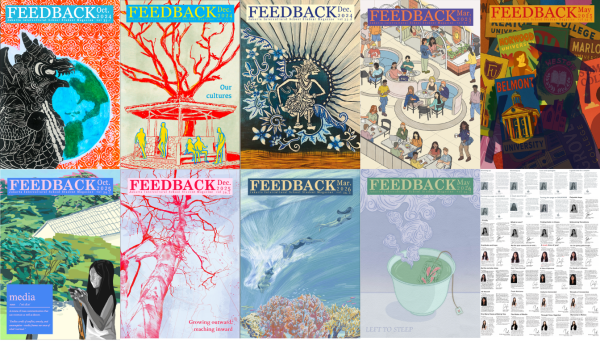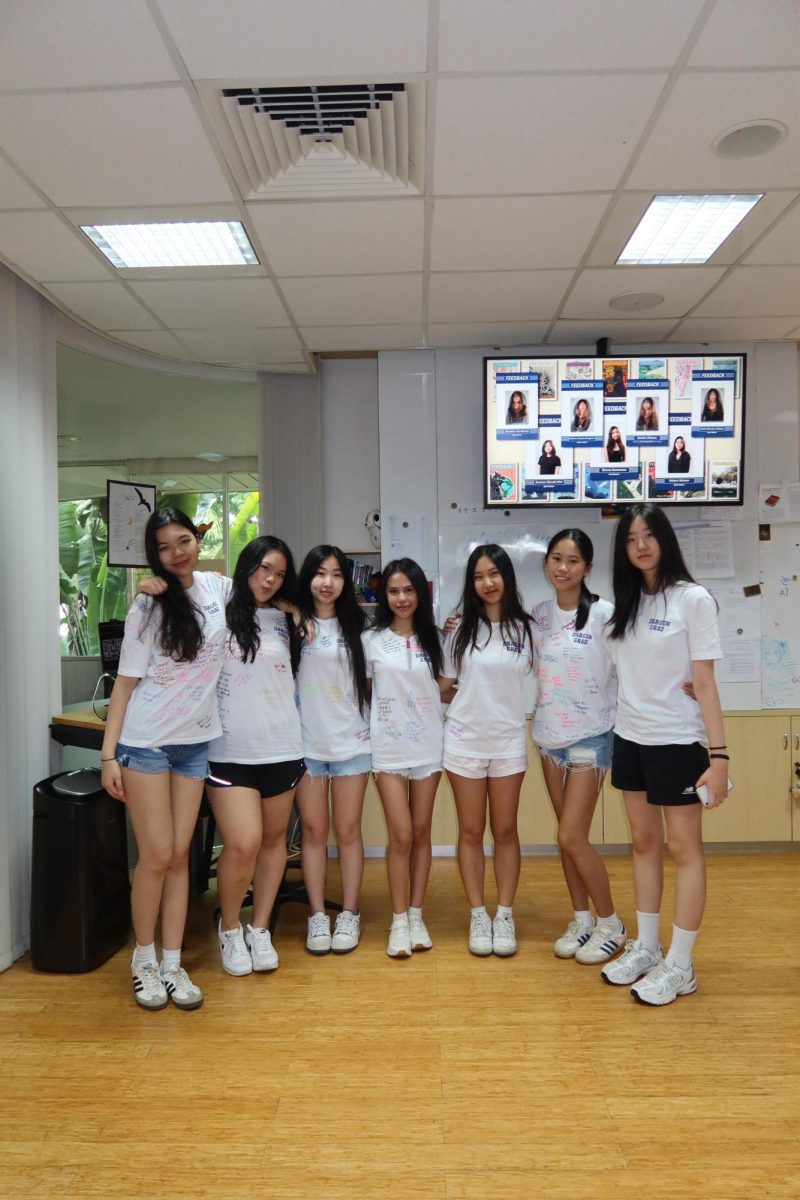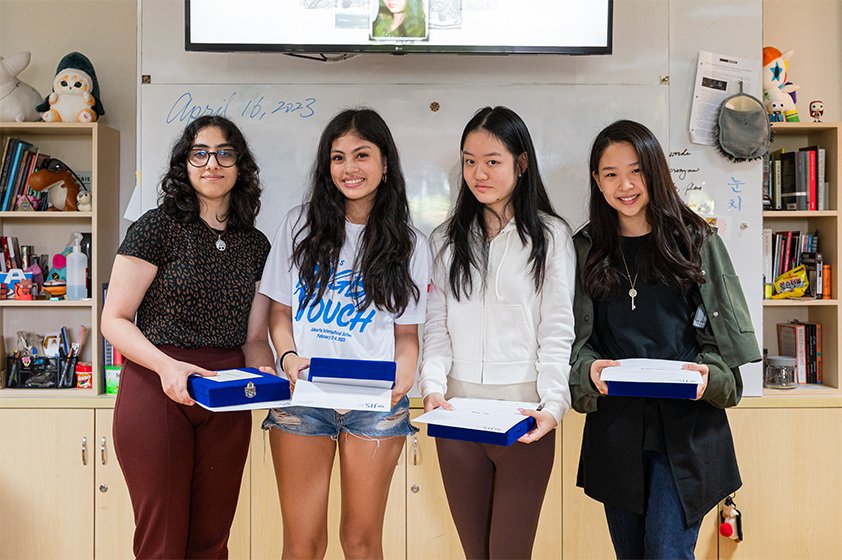



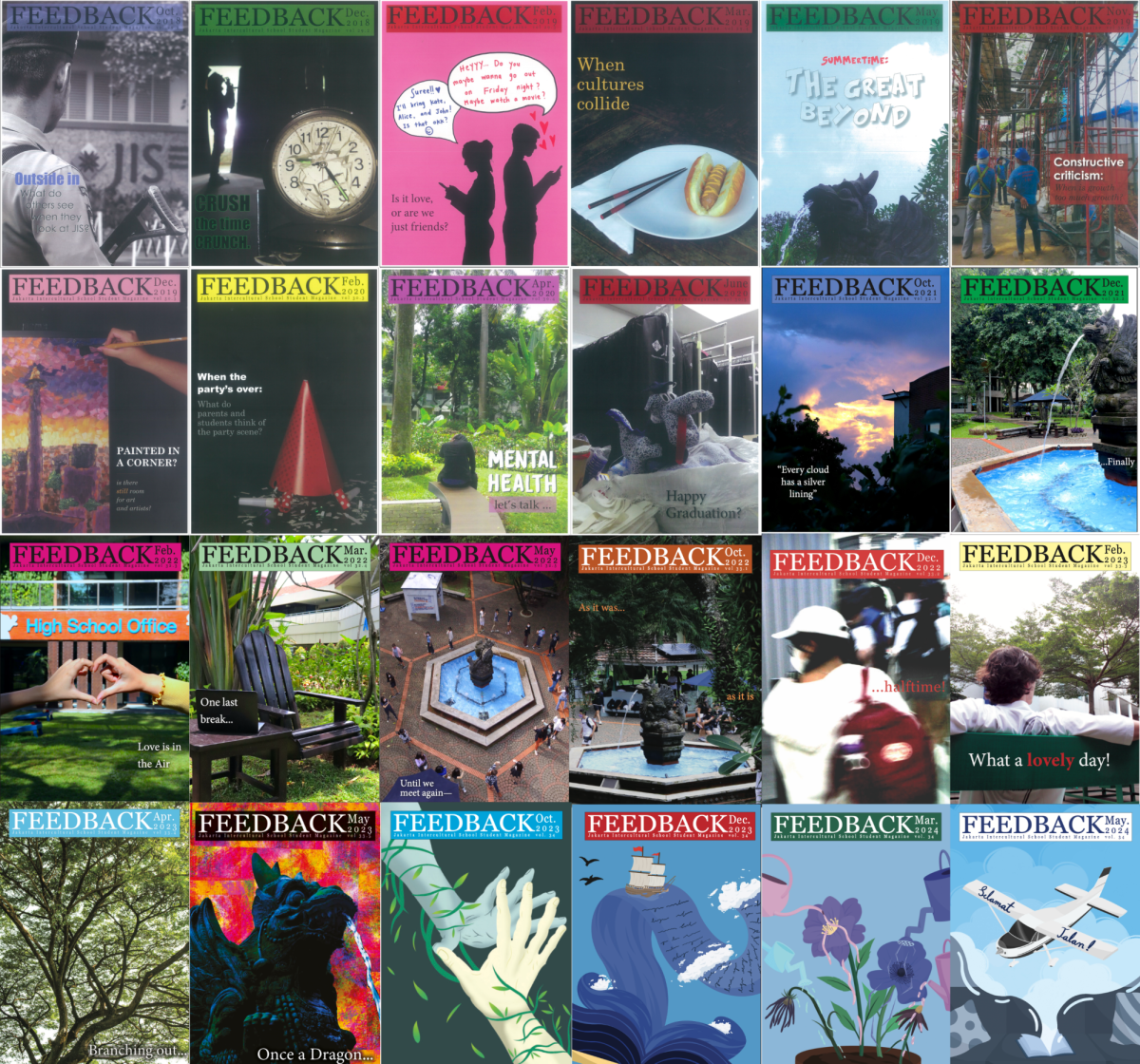
Feedback is built by a team—writers, editors, and artists, each contributing to the publication in different ways. Among them is the editor-in-chief, a position that passes from one person to the next, carried for a limited time before being handed off.
Over the past several years, that position has been held by Victoria Budiono (2018-2020), Putri Srijaya (2021-2022), and Cahaya Ratomo (2022-2024). This year marks the end of my own tenure in the role and my three years at Feedback, bringing to a close one of the most significant parts of my time at JIS.
Although each editor-in-chief inherits the same position, no two manage their responsibilities in quite the same way.
Victoria Budiono (2018-2020)
When Victoria first became editor-in-chief, she expected the role to revolve primarily around writing. Instead, much of her experience became centered around people: motivating writers, directing conversations, and figuring out how to create momentum within the newsroom.
Part of that challenge came from engagement. Not everyone entered the class with the same level of investment, and leading the publication often meant finding ways to make the process feel meaningful even for those who were not as devoted to it.
At the same time, Victoria had to navigate the uncomfortable balance between being a peer and a leader. The role required her to be slightly more outspoken and decisive while still remaining approachable within a room full of peers.
Much of that uncertainty extended beyond the newsroom itself. She also became deeply aware of readership—the unpredictability of spending weeks refining an issue without knowing how it would ultimately be received by the wider JIS community.
However, rather than avoiding difficult subjects because of that uncertainty, Victoria moved toward them.
“If people don’t want to talk about it, then I’m going to write about it,” she said.
During her tenure, she became especially proud of articles surrounding mental health and other topics that students or administrators often labeled as “taboo.”
For her, Feedback became a space for difficult conversations to take place openly rather than remain hidden behind discomfort or fear.
Looking back, much of what defined Victoria’s leadership was her willingness to push conversations further than where they initially began—not only within articles themselves, but within the publication as a whole.
Putri Srijaya (2021-2022)
Putri entered the role during a period when much of student interaction still existed through screens. Meetings happened online, discussions unfolded through shared documents and group chats, and leading the publication meant trying to sustain connection despite physical distance.
As she led the team during COVID-19 hybrid learning, structure became especially important throughout her tenure. Strict deadlines, organization, and clear expectations helped keep the team productive while much of the publication operated through screens.
At the same time, the experience taught her that leadership depended just as much on listening to others and understanding each staff writer individually as it did on directing.
One of the moments she remembers most clearly came when the team finally gathered in-person for the first
time.
“To feel like I knew everyone well, even though I hadn’t met some of them in person before, was unforgettable,” she said.
Returning to campus changed the way she understood Feedback. The publication no longer felt defined solely by the final printed issues themselves, but by the relationships and familiarity that had developed alongside the writing.
Putri described one of the hardest parts of being editor-in-chief as “motivating the troops”—maintaining morale and momentum during a period where uncertainty surrounding the pandemic affected nearly every aspect of student life.
Yet what remained most meaningful to her was the pride that emerged as the team began rebuilding that sense of connection together.
She also spoke about how much the editors-in-chief who preceded her influenced her approach to both writing and leadership.
In many ways, Feedback shaped the way she understood collaboration—not as individual people working separately, but as a group gradually learning to trust one another enough to create something collectively.
Cahaya Ratomo (2022-2024)
Having been a staff writer for Feedback during hybrid learning before returning in-person as editor-in-chief, Cahaya found herself stepping into a visibility she had not fully anticipated nor was familiar with.
The role demanded more than editing drafts behind the scenes. It required constant presence—checking in with writers individually, guiding them through conversations with fellow editors and advisors, making difficult decisions, and learning how to support everyone on the team while still maintaining standards for the publication.
It also meant accepting how much of the process would remain invisible. Long hours of revisions, editor meetings on themes and layouts, and the pressure of trying to ensure each issue reflected the team’s collective effort often happened long before readers ever saw the final products.
Still, those unseen parts of the process became some of the most meaningful.
“I was really proud of the relationships I built [within the team],” she said. “It was really a unique and gratifying experience to work with a group of people where everyone really wanted to be there and be passionate about their ideas.”
That sense of commitment deeply shaped her experience in the role. To Cahaya, Feedback functioned more like a newsroom—one where students shaped the publication through their writing while simultaneously being shaped by the collaboration, accountability, and responsibility required to produce it.
One of the most rewarding parts of the role for Cahaya was watching those dynamics evolve over time: seeing writers become more confident, discussions become more thoughtful, and each issue become more reflective of the people behind it rather than only the theme itself.
Mishka Fangiono (2024-2026)
When I first became editor-in-chief, I was trying too hard to resemble what I thought one was supposed to look like.
Having worked under Cahaya, I entered the role assuming leadership meant always appearing composed and certain—knowing how to solve every problem immediately, keeping discussions under control, and carrying the same confidence and eloquence I had admired in her and Putri.
Yet, imposter syndrome followed me into nearly every decision, mistakes felt larger than they probably were, and moments of uncertainty often felt like proof that I was not fully suited for the role.
As the weeks went by, however, much of that doubt slowly gave way to a sense of comfort and reassurance. I began trusting in myself—that the people who entrusted me with the role had done so because they saw something in me that I had not yet fully learned to see in myself.
As a result, I began to realize that leadership within Feedback was never meant to look identical from one editor-in-chief to the next. Different problems would arise, deadlines were always stressful, and every issue unfolded imperfectly but smoothly.
Gradually, I learned how to steer those moments in a way that felt natural to me rather than trying to navigate them like someone else.
Much of that growth came from the people surrounding me.
Over the past two years, I have deeply valued every editor, writer, and advisor I have had the opportunity to work alongside, all of whom have shaped my leadership in different ways.
Some of the most rewarding moments came when I could briefly step back and realize the publication no longer depended entirely on my direct involvement in every small detail.
Watching the team function collaboratively on its own—seeing writers edit each other’s work, contribute ideas independently, and sustain the atmosphere of the newsroom together—made me realize that leadership within Feedback was about helping create an environment where people felt capable of contributing meaningfully to it themselves.
In many ways, those moments made my tenure at Feedback so deeply meaningful, worthwhile, and unforgettable.
What Remains
Although each editor-in-chief inherited the same position and responsibilities, no two left with the same understanding of what the role meant to them. Much of that difference comes from the fact that being editor-in- chief of Feedback is an experience unlike any other in high school.
An editor-in-chief leads, but does not dominate. They guide discussions, but do not control them entirely; remain approachable, but still uphold standards; support each person on the team, but do not make them dependent on that support. The role requires existing simultaneously as both peer and leader, collaborator and decision-maker—a unique experience.
In the end, the legacy of Feedback exists not only within its pages, but within the people who carry the experience of creating them long after their own tenure comes to an end.
The newsroom changes hands, new voices take shape, and the publication continues forward—but some parts of it remain with every person who once called it home.
Students eventually leave the newsroom just as they eventually leave the school itself, taking with them lived experience in communication, responsibility, and meaningful collaboration—skills that are difficult to cultivate anywhere else in quite the same way.
While this experience is unique to those privileged enough to enroll in Advanced Journalism, the lesson behind it is not exclusive.
JIS hopes to prepare students to be the best for the world, but before that, students must ask themselves what communities they are part of, and how they choose to contribute to them, because becoming better for the world begins with learning how to be better for one another.